时间:2026年1月20日 上午10:30
地点:无线谷A3楼3303室
Title:
Recent Advances in Fluid Antennas
With the global research community intensifying efforts toward realizing sixth-generation (6G) mobile communications, it has become essential to explore innovative technologies capable of delivering breakthroughs in performance, flexibility, and resilience under challenging environments. Among the emerging paradigms, the fluid antenna system (FAS) stands out as a highly promising concept that redefines the traditional notion of fixed antenna infrastructure. A fluid antenna leverages flexible and reconfigurable architectures—such as liquid-metal antennas, pixel-based reconfigurable antennas, and stepper motor-driven movable radiators—to enable the dynamic repositioning of antenna ports within a spatial region.
This unique capability to reposition the antenna port across space introduces an unprecedented form of space diversity. By accessing a nearly continuous fading envelope in the spatial domain, FASs can effectively combat small-scale fading and interference in ways that conventional multi-antenna systems cannot easily achieve. Moreover, such spatial agility opens up new opportunities for multiple access and interference suppression, accomplished with minimal signal processing complexity. The result is a communication system that is not only highly adaptive but also inherently robust to the random nature of wireless propagation.
Recent research has advanced both the theoretical understanding and experimental realization of fluid antennas. Studies have demonstrated their potential in enabling compact, power-efficient, and high-performance wireless transceivers suitable for 6G and beyond. Experimental prototypes using conductive fluids and programmable platforms have validated the feasibility of achieving high diversity gains and improved link reliability. In this presentation, we will highlight the most recent progress in fluid antenna research, covering aspects from analytical modeling to prototype development, and discuss the exciting prospects of this emerging technology in shaping the future of reconfigurable and intelligent wireless communication systems.
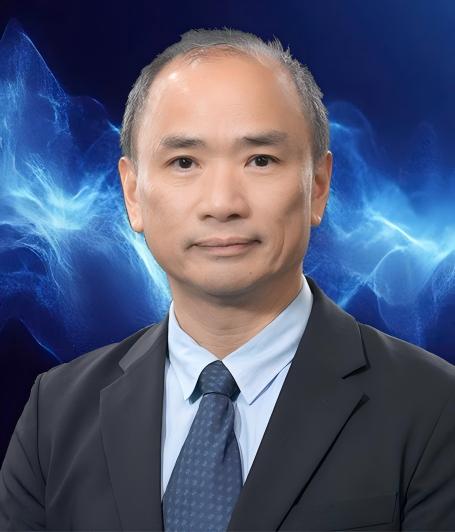 Professor Kin-Fai (Kenneth) Tong is a Chair Professor of Antennas and Applied Electromagnetics at Hong Kong Metropolitan University (HKMU), where he leads research in wireless communication technologies, after serving UCL for 20 years.
He is a Fellow of IEEE USA, a Fellow of IET and a Chartered Engineer in the UK, and a Fellow of the Electromagnetics Academy (MIT, USA). He serves as aSubject Editor for Antennas for IET Electronics Letters and theLead Guest Editor for the IEEE Open Journal of Antennas and Propagation for the Special Section on Recent Advancements in Liquid Antennas and Their Applications in 2020. He was theGeneral Chair for the IEEE iWEM 2017 and theTPC Co-Chair of the IEEE MTT-S International Microwave Workshop Series on RF and Wireless Technologies for Biomedical and Healthcare Applications.
He has a strong track record in novel wideband antennas, circularly polarised patch antenna designs and microwave/mmWave techniques. He is active in knowledge transfer; his Innovate UK project was graded as “OUTSTANDING”, i.e., the top 5% among all projects. The project was reported in theParliamentary Review of the UK. He won the UCL Knowledge Transfer Business of the Year Award 2015 and the 2017 UCL Provost’s Spirit of Enterprise Award. Prof Tong is also actively working in fluid antennas, surface waves and wideband mmWave transducers for future wireless communications systems.